Your surgeon said you need cervical fusion. Then came a wave of terms nobody explained. Maybe they called it ACDF. Maybe neck fusion. Maybe anterior cervical discectomy and fusion, which is a mouthful nobody remembers. All the same operation, just different names for it.
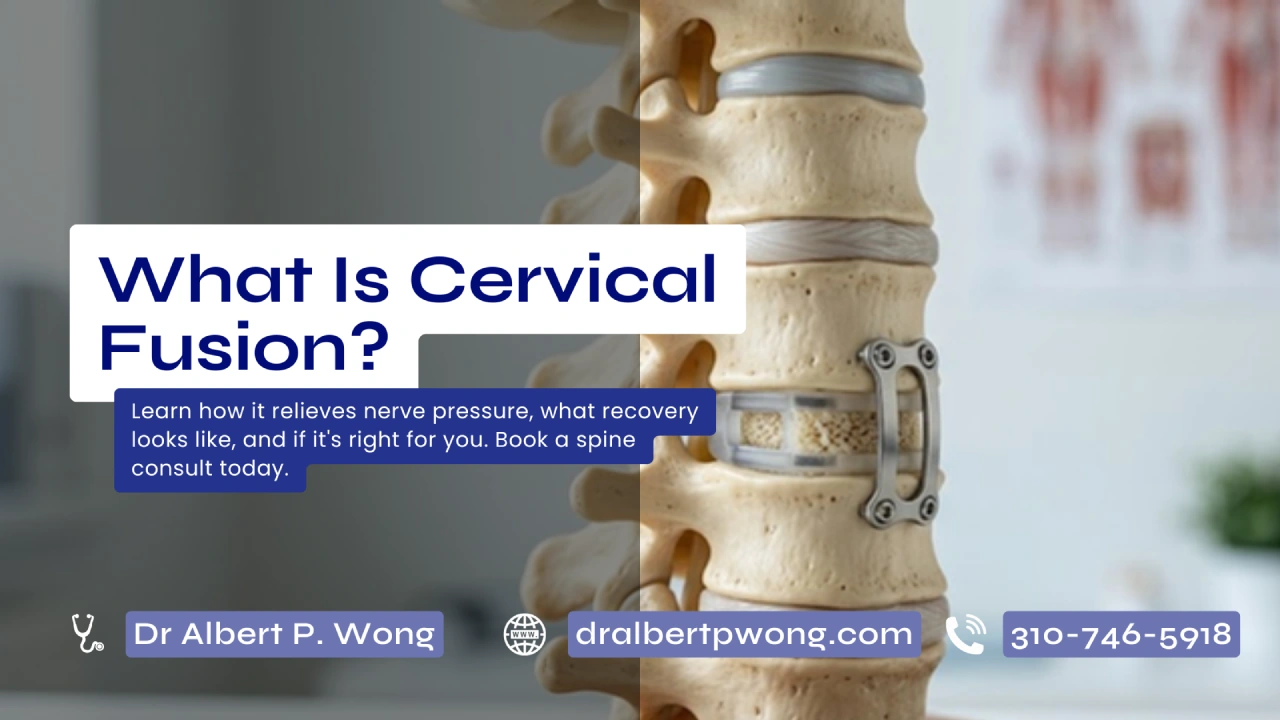
The idea behind it is simple enough. Join two neck vertebrae, sometimes more, and let them heal into one piece of bone. But something has to come out first, whatever happens to be pressing on your nerves. Only then does your surgeon deal with the space that’s left.
So here’s the whole thing about ‘what is cervical fusion’, start to finish.
What Cervical Fusion Actually Does
Seven vertebrae stack up to form your neck. Soft discs cushion the space between each one.
Trouble starts when a disc wears out or herniates, or when arthritis crowds the space around your spinal cord. Nerves get compressed. And what you feel afterward depends entirely on which nerve took the hit. Could be neck pain. Could be pain running down your arm, or numbness, or weakness that shows up when you grip something.
Two steps solve it.
Decompression comes first. Out comes whatever is pressing on that nerve, whether a damaged disc or a bone spur. Then comes stabilization. Pulling a disc out leaves a gap behind, and that gap needs filling, so a spacer goes in. Your own bone grows through it over the months that follow.
Eventually the two vertebrae stop behaving like two vertebrae. They work as one.
Anterior vs. Posterior: Two Ways In
Your surgeon reaches your spine from one of two directions. Which one depends on where the problem sits.
Anterior means through the front of your neck, and it’s the approach used most often. A small incision near your throat gives access. Muscles get moved aside instead of cut through.
Posterior means through the back of your neck. This works better for problems affecting several levels, or when compression comes from behind the spinal cord.
That difference shows up later, in how much the recovery hurts.
Why Your Surgeon Might Recommend It
Fusion isn’t a first step. Most patients try conservative care for weeks or months before surgery comes up.
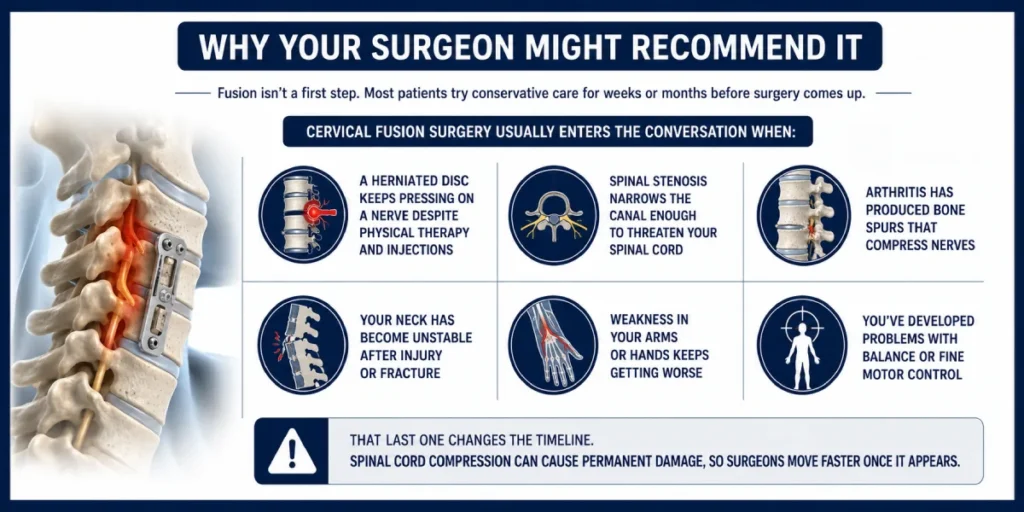
Cervical fusion surgery usually enters the conversation when one of these applies:
- A herniated disc keeps pressing on a nerve despite physical therapy and injections
- Spinal stenosis narrows the canal enough to threaten your spinal cord
- Arthritis has produced bone spurs that compress nerves
- Your neck has become unstable after injury or fracture
- Weakness in your arms or hands keeps getting worse
- You’ve developed problems with balance or fine motor control
That last one changes the timeline. Spinal cord compression can cause permanent damage, so surgeons move faster once it appears.
What Happens During Surgery
Most cervical fusions take one to three hours, depending on how many levels need work.
You’ll be under general anesthesia, so you won’t feel or remember anything. Your surgeon makes a small incision, removes the damaged disc or bone, and places a spacer in the empty space. That spacer might be your own bone, donor bone, or a synthetic implant. A small plate and screws often hold everything steady while it heals.
Many patients go home the same day or after one night.
How Painful Is It?
Worth answering directly, because the two approaches genuinely differ.
Anterior fusion tends to hurt less. Your surgeon moves muscles aside instead of cutting through them. Most people describe moderate soreness that eases within two weeks. A sore throat and some trouble swallowing are common for the first few days, since the approach passes near your esophagus.
Posterior cervical fusion is generally more painful early on. Reaching the spine from behind means cutting through neck muscles, and muscle takes longer to settle than a small anterior incision. Expect more soreness for the first few weeks.
Both are manageable with medication. Pain typically drops off noticeably between two and four weeks.
Recovery: What to Expect
Two timelines run at once here, and they move at different speeds.
You’ll feel better long before the bone finishes healing. Arm pain often improves right away, because the pressure disappears the moment the disc comes out. Neck soreness fades over several weeks.
The bone takes much longer. Full fusion usually needs three to six months, sometimes closer to a year.
Here’s a rough guide to the milestones:
- First week: rest, short walks, limited activity
- Weeks two to four: soreness eases, light daily activity returns
- Weeks four to six: many people go back to desk work
- Three months: most restrictions lift, physical therapy often begins
- Six to twelve months: bone fusion completes
Physical jobs take longer. So do multi-level fusions.
What to Avoid After Cervical Fusion
Your habits during the first few months genuinely affect whether the bone fuses properly. This part is worth taking seriously.
Avoid these while you heal:
- Smoking and nicotine. This is the big one. Nicotine significantly reduces fusion rates and raises the risk of hardware problems.
- Heavy lifting. Most surgeons cap it around five to ten pounds early on.
- Bending, twisting, and reaching overhead. All three stress the healing level.
- Driving until you’re off narcotic pain medication and can turn your head safely.
- Long stretches of sitting still. Short frequent walks reduce clot risk and keep you mobile.
Ask about anti-inflammatory medication rather than assuming. Research on whether drugs like ibuprofen affect bone healing is genuinely mixed, though short courses appear safer than prolonged use. Your surgeon will tell you what fits your case.
Follow their instructions over anything you read online. Restrictions vary by approach and by how many levels were fused.
Risks Worth Knowing
Cervical fusion has a strong safety record, and most patients do well. You should still understand the risks before consenting.
Short-term possibilities include infection, bleeding, difficulty swallowing, and hoarseness from irritation of the nerve that controls your vocal cords. Most swallowing and voice problems clear within weeks.
Sometimes the bone doesn’t fuse completely. Surgeons call this nonunion. It happens more often in smokers and in multi-level fusions, and it occasionally requires a second procedure.
Then there’s the longer-term tradeoff. Fusing one level means the levels above and below absorb more motion than before. Over years, that added stress can wear those discs faster. Surgeons call it adjacent segment disease. It doesn’t happen to everyone, and not everyone who develops it needs more surgery. But it’s a real reason surgeons fuse as few levels as possible.
Fusion or Artificial Disc?
Fusion isn’t your only option anymore.
Cervical disc replacement removes the damaged disc and puts an artificial one in its place. Rather than joining two vertebrae, it preserves motion at that level.
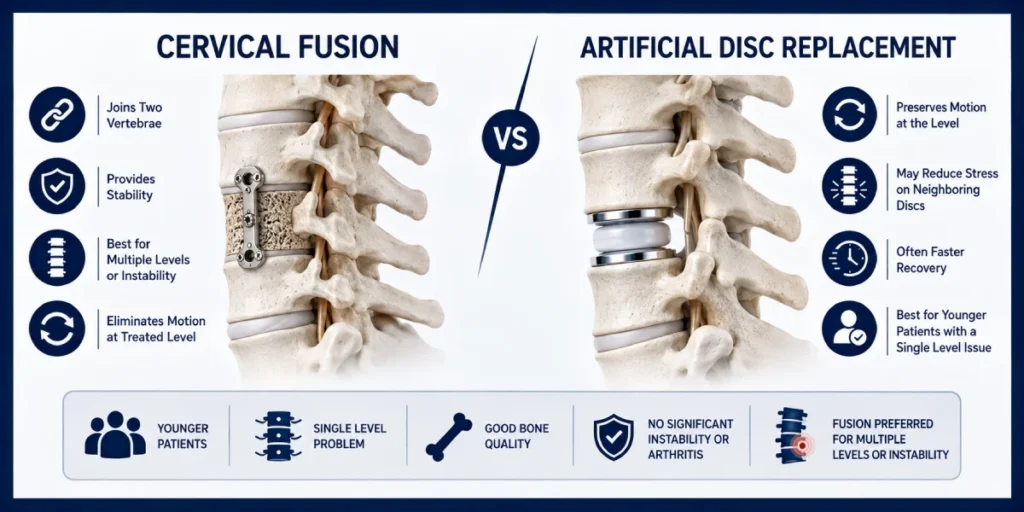
The appeal is obvious. Keeping motion may reduce stress on neighboring discs, and recovery is often faster.
It doesn’t suit everyone, though. Disc replacement generally works best for younger patients with a single problem level, good bone quality, and no significant instability or arthritis. Fusion remains the better choice when the spine needs stabilizing or several levels are involved.
Ask your surgeon which applies to you. The honest answer depends on your imaging and your specific condition.
Will You Lose Neck Movement?
Less than most people fear.
Your neck has seven vertebrae sharing the work of turning and bending. Fusing one level removes that segment’s contribution, and the rest compensate. Most single-level patients notice little difference day to day.
Multi-level fusions are another story. Fusing three or four levels does noticeably reduce your range of motion. Your surgeon can tell you what to expect based on how many levels you need.
Final Thought
Cervical fusion relieves nerve pressure and stabilizes your neck. It has decades of evidence behind it, and most patients get lasting relief.
The parts that matter most are the ones people tend to skip. Understand which approach you’re having and why. Take the restrictions seriously, especially around nicotine. Ask whether disc replacement is an option in your case.
Feeling uncertain before spine surgery is normal. Most of that uncertainty comes down to not knowing what to expect, which is fixable. Write your questions down and bring them to your next appointment.
Frequently Asked Questions
How long does cervical fusion last?
For most people, permanently. The fused bone becomes solid and stays that way, and the hardware is designed to remain in place for life. What can change over time is the health of neighboring discs.
Can a cervical fusion fail?
Occasionally. The bone may not fuse completely, or hardware can loosen. Smoking raises both risks considerably. When a fusion fails, revision surgery is possible, and the right approach depends on what went wrong.
When can I drive after cervical fusion?
Usually two to four weeks, though it depends on your medication and your neck mobility. You need to be off narcotic painkillers and able to check your blind spots comfortably.
Is cervical fusion surgery worth it?
For the right patient, yes. Success rates for relieving arm pain caused by nerve compression are high. It works less predictably for neck pain alone, which is why surgeons stay more cautious in those cases.