
Your head pain might not start in your head. Sometimes it begins a few inches lower, in the joints and nerves of your upper neck. Then it climbs. You might feel pressure behind one eye. Or an ache across your temple. Or tightness gripping the base of your skull.
So can a pinched nerve cause headaches? Yes. And they often copy migraines well enough to send people down years of the wrong treatment. Doctors have a term for this. Referred pain. The problem sits in one place. You feel it somewhere else.
How Neck Nerves Send Pain Into Your Head
Your top three neck nerves, called C1 through C3, carry feeling to your scalp, the back of your head, and part of your face.
Here’s what explains everything. Those nerves share a relay point in your brainstem with the trigeminal nerve. That nerve handles your forehead and the area around your eyes. Two signals arrive on one pathway. Your brain knows something hurts. It can’t always tell you where the trouble started.
That mix-up creates two conditions worth knowing.
Cervicogenic headache means head pain that actually starts in your neck. Doctors call it a secondary headache. Something else causes it. A pinched nerve counts. So does arthritis. So do whiplash and a damaged disc.
Occipital neuralgia affects the occipital nerves. These branch off your C2 and C3 nerve roots and run up through your scalp. Pressure or swelling along that path sets it off. About 3.2 percent of people get it. Most are between 60 and 69.
What Causes the Nerve to Get Pinched
Your neck nerves squeeze through openings barely wider than the nerves themselves. There’s almost no spare room. Anything that shrinks that gap presses right on the nerve. Bone. Disc material. Swollen tissue. A muscle in spasm.
Age explains many cases. Posture explains a surprising number of the rest.
Here’s what typically narrows the space:
- Arthritis in your neck joints
- A herniated or bulging disc pushing on a nerve root
- Whiplash and other neck injuries
- Forward head posture from hours spent looking down at screens
- Tight muscles at the base of your skull squeezing the nerve
- One bad night of sleep
Your job matters too. Truck drivers work with their heads pushed forward all day. So do hairstylists and carpenters. Your upper neck takes that load.
What This Headache Actually Feels Like
You’ll recognize the pattern once you know it.
Pain usually starts at the base of your skull or on one side of your neck. Then it climbs. It reaches the back of your head. Sometimes your temple. Often it settles behind one eye. Most people call it steady and dull rather than pounding.
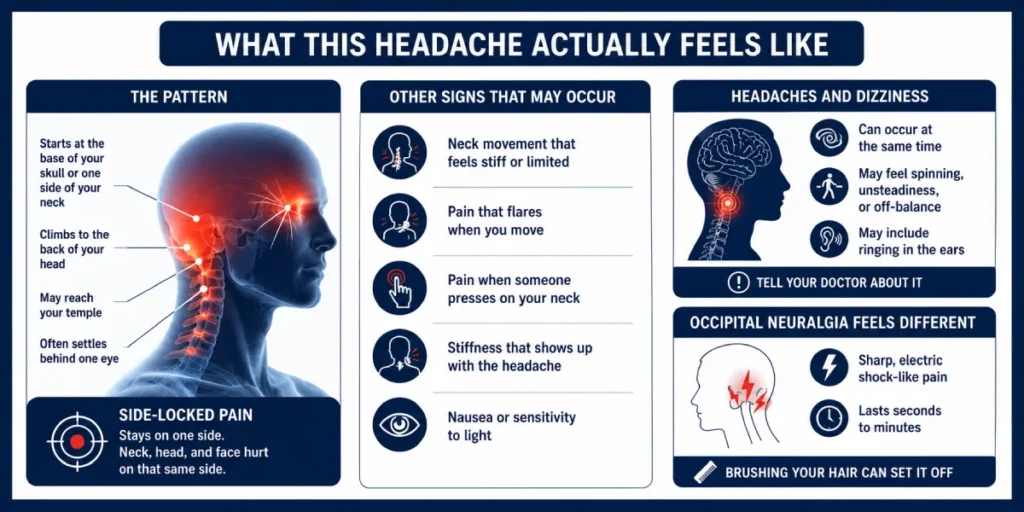
Doctors call it side-locked. That’s your best clue. The pain picks one side and stays there. Your neck, head, and face all hurt on that same side. Migraines switch sides. These don’t.
A few other signs tend to show up alongside the pain. You might also notice:
- Neck movement that feels stiff or limited
- Pain that flares when you move
- Pain when someone presses on your neck
- Stiffness that shows up with the headache
- Nausea or sensitivity to light
Can a pinched nerve cause headaches and dizziness at the same time? It can. Cervicogenic dizziness happens when those same neck structures disturb your balance. You might feel spinning. Or unsteadiness. Or ringing in your ears. Tell your doctor about it. Don’t treat it as a separate issue.
Occipital neuralgia feels different. Instead of a steady ache, it fires sharp electric shocks. They last seconds to minutes. Brushing your hair can set one off.
Why It Gets Mistaken for Migraine
Pain on one side. Nausea. Light bothering you. On a symptom list, the two look nearly identical.
What separates them is where they start. Migraine starts in your brain. This kind starts in your neck. It only shows up in your head.
Telling them apart comes down to a few specific clues. Watch for these signs pointing to your neck:
- Moving your neck triggers or worsens the pain
- Pressing certain spots brings the headache back
- The same side hurts every time
- Your neck got stiff before the headaches began
- Migraine medication barely helps
That last one matters. When treatment keeps underperforming, the diagnosis is often wrong.
How Doctors Confirm the Diagnosis
No single test settles this. Your doctor pieces it together from several angles.
They’ll start with your history and a physical exam. They’ll move your neck through its full range. They’ll press on specific spots and watch to see if your headache comes back. They’ll check your reflexes, strength, and feeling too. That tells them whether a nerve root is involved.
Imaging comes next if the exam points to something structural. An MRI shows your discs, nerve roots, and soft tissue. A CT scan shows bone more clearly. It works if you can’t have an MRI. X-rays show alignment and arthritis. They can’t show nerves at all.
Keep this in mind. Scans regularly show wear and tear in people who feel completely fine. Imaging backs up what your doctor found in the exam. It doesn’t replace it.
Sometimes a nerve block gives the clearest answer. Your doctor numbs one specific nerve. If your headache disappears, that nerve was probably the source. False positives happen in up to 40 percent of cases. A second block often confirms it.
Treatment That Actually Helps
Good treatment fixes your neck instead of medicating your head. That’s why painkillers alone rarely solve these headaches.
Conservative Care First
Most people start here and never need anything more.
Physical therapy does most of the work. You’ll correct your posture. You’ll strengthen the deep muscles at the front of your neck. You’ll get hands-on treatment to loosen stiff joints. Anti-inflammatory medication helps in the short term. If regular painkillers don’t touch it, nerve-pain medication sometimes works instead.
Small changes at home matter more than you’d expect. Raise your monitor to eye level. Switch to a pillow that supports your neck instead of propping it up. Take breaks from screens. Each one takes pressure off your upper neck.
Injections and Nerve Blocks
If conservative care stalls, your doctor may inject the area around the affected nerve. This calms the swelling. It often gives you months of relief. It confirms the diagnosis at the same time.
Some people get real relief but only briefly. For them, radiofrequency ablation quiets the nerve’s pain signals for much longer.
When Surgery Enters the Picture
Rarely. Surgery only makes sense when a scan shows something clearly pressing on a nerve. Everything else has to have failed first. A herniated disc would meet that bar. So would a badly narrowed space at your C2 or C3 nerve.
When to Get It Checked
For most of these headaches, the pattern matters more than how long they’ve lasted. A few weeks of neck pain rarely means anything dangerous.
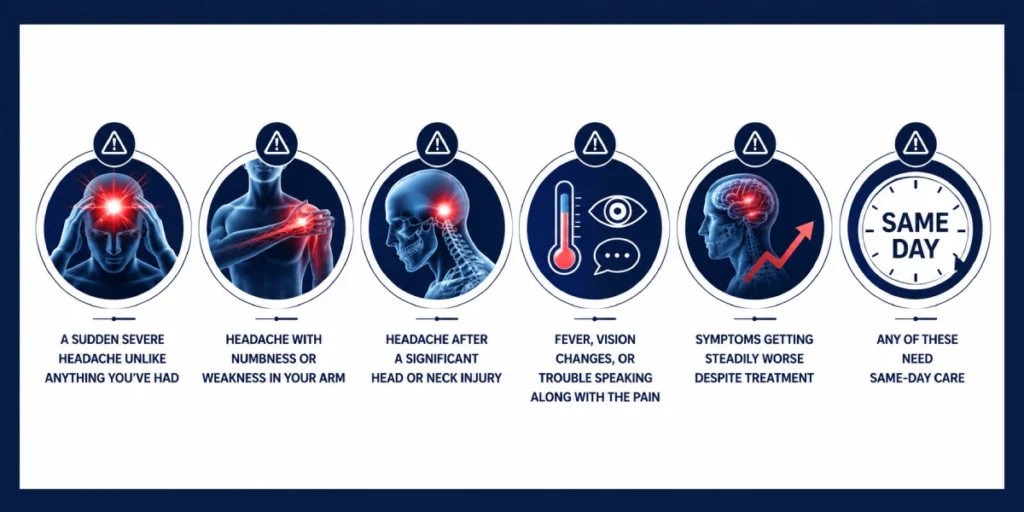
But some symptoms break that rule. They can point to bleeding, infection, a fracture, or a badly compressed nerve. Those need attention within hours.
Most neck headaches frustrate you rather than endanger you. These don’t fall in that group:
- A sudden severe headache unlike anything you’ve had
- Headache with numbness or weakness in your arm
- Headache after a significant head or neck injury
- Fever, vision changes, or trouble speaking along with the pain
- Symptoms getting steadily worse despite treatment
Any of these need same-day care.
Final Thought
Can a pinched nerve cause headaches? Yes. And knowing that changes how you treat them. Pain that starts in your neck won’t respond to headache medication. The medication never reaches what’s causing it.
The pattern usually shows itself. One side, every time. Neck stiffness that came first. Movement that reliably makes it worse. Migraine treatment that never quite works.
If that sounds like your headaches, especially after months of them, a spine specialist can find out whether a compressed nerve is behind them. Finding the cause is what finally brings relief.
Frequently Asked Questions
How long does a pinched nerve headache last?
Anywhere from a few hours to several months. It depends on what’s pressing on the nerve. A headache from one bad night of sleep usually clears in days. Arthritis or a herniated disc causes something more stubborn. That version sticks around until you treat the cause.
Can a pinched nerve headache go away on its own?
Sometimes. If muscle tension or temporary irritation caused it, things often settle by themselves. Structural problems work differently. Bone spurs and disc material don’t retreat. Those headaches tend to come back until something changes.
Which side of the head does a cervicogenic headache affect?
A cervicogenic headache affects one side, and reliably the same one. Pain usually runs from the base of your skull up to your temple or behind your eye. If your headaches switch sides between episodes, that points to migraine instead.