Back pain seldom explains itself, and two diagnoses are sometimes confusing! Actually, ‘spinal stenosis vs herniated disc’ both compress a nerve. Pain travels down an arm or a leg either way. Both appear on MRI reports full of terminology that clarifies nothing for the person reading it at home. And that is usually where the confusion begins.
Most patients have already read about each condition. Few can say which one matches what they feel. Why does the distinction matter? Different timelines. Different causes. Treatment that does not always overlap.
What Is Spinal Stenosis?
A bony tunnel encloses your spinal cord and nerve roots. Stenosis describes what happens when that tunnel narrows until the nerves lose the space they need.
It happens slowly. Years, often decades. This is wear, not injury.
Common contributors:
- Arthritis and bone spurs growing into the canal
- Ligaments thickening with age
- A bulging or herniated disc taking up canal space
- A canal that was narrow from birth
- Spondylolisthesis, one vertebra sliding forward over the next
Worth knowing: wear on a scan and pain in a patient are different things. Plenty of people over 60 show degeneration and feel nothing.
Cervical vs. Lumbar Spinal Stenosis
Location changes everything, because the spinal cord only runs partway down the spine.
Cervical spinal stenosis affects the neck, where the cord is still present. Neck pain, plus numbness or weakness into the shoulders, arms, and hands. Advanced cases bring balance problems and clumsiness with small movements. Buttons take longer. Handwriting gets worse without explanation.
Lumbar spinal stenosis is more common. The cord ends near the top of the lower back, so this compresses individual nerve roots instead. Pain, cramping, and weakness through the buttocks and legs, worse the longer you stand or walk.
What Is a Herniated Disc?
Each vertebra sits on a disc: tough fibrous ring outside, soft gel center inside. The ring tears, the gel pushes out, and it lands on a nerve root.
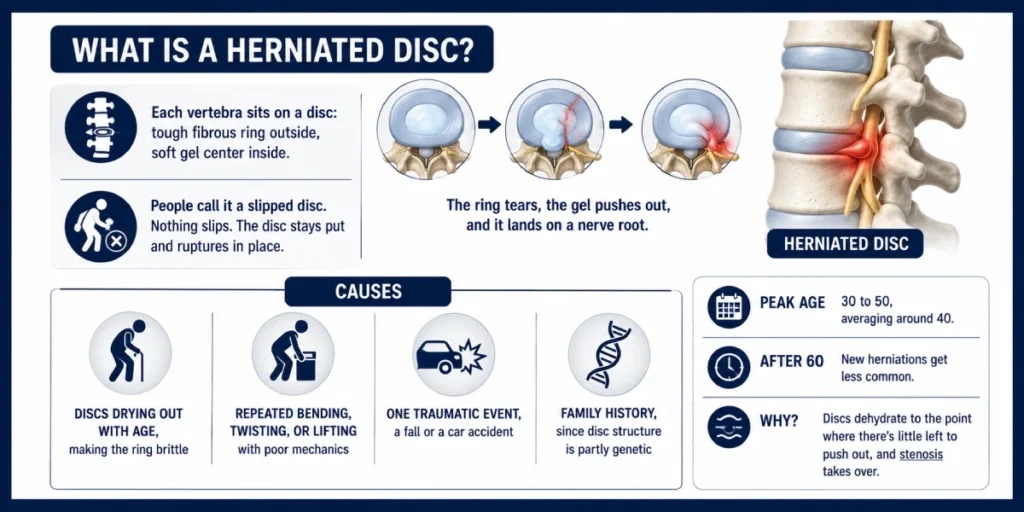
People call it a slipped disc. Nothing slips. The disc stays put and ruptures in place.
Causes:
- Discs drying out with age, making the ring brittle
- Repeated bending, twisting, or lifting with poor mechanics
- One traumatic event, a fall or a car accident
- Family history, since disc structure is partly genetic
Peak age is 30 to 50, averaging around 40. Oddly, new herniations get less common after 60. Discs dehydrate to the point where there’s little left to push out, and stenosis takes over.
Cervical vs. Lumbar Disc Herniation
Cervical disc herniation hits the neck, usually at the two lowest levels. Pain, numbness, or weakness into the shoulder, arm, or hand. Which fingers go numb tells a surgeon which root is involved.
Lumbar disc herniation is far more common, concentrated at the two lowest levels of the lower back. This causes most sciatica, where pain runs from the lower back through the buttock and down the leg.
Spinal Stenosis vs Herniated Disc: Key Differences at a Glance
General knowledge of the key differences is useful before planning. Five factors separate these conditions cleanly, and knowing where yours falls on each one usually points toward the right diagnosis before any scan confirms it.
Here is how spinal stenosis vs herniated disc compare:
| Spinal Stenosis | Herniated Disc | |
| Cause | Gradual narrowing from arthritis, bone spurs, thickened ligaments | Tear or rupture of a single disc |
| Typical age | Most common after 50 | Peaks between 30 and 50 |
| Onset | Slow, progressive | Often sudden |
| Mechanism | Diffuse narrowing along the canal | Localized pressure at one level |
| Progression | Worsens over years | Often improves within weeks |
Comparing Symptoms: How Do They Feel Different?
Both produce radiating pain, numbness, and weakness. The useful question isn’t what hurts. It’s what brings the pain on and what settles it.
That pattern separates spinal stenosis symptoms from herniated disc symptoms before imaging confirms anything.
Spinal Stenosis Symptoms
The classic finding is neurogenic claudication. Leg pain and heaviness that build while walking, then fade within minutes of sitting.
Patients describe this in distance, not intensity. Four blocks last year, one block now. Leaning forward helps, which is why the grocery store feels easier than the parking lot. The cart provides the forward lean that opens the canal.
Also common:
- Legs that feel unsteady or give out while walking
- Balance trouble, often first noticed on stairs
- Cramping and numbness that build with activity
- In neck cases, hand numbness and reduced dexterity
Herniated Disc Symptoms
Different rules. Disc pain tracks one nerve and reacts to movement, not duration.
- Sharp pain radiating down one arm or leg
- Numbness or tingling along that nerve’s path
- Weakness in one isolated muscle group
- Pain that spikes with coughing, sneezing, or bending forward
That last one is diagnostically useful. Coughing briefly raises pressure inside the canal. A herniated disc reacts. Stenosis usually doesn’t.
Simple rule: stenosis pain answers to position, disc pain answers to movement.
Can You Have Both Conditions at the Same Time?
Yes, and they aren’t always separate problems.
A herniated disc can push into the canal and reduce its diameter. That’s stenosis by definition, caused by a disc instead of arthritis. The two can also coexist with no relationship at all, narrowing at one level and a herniation somewhere else.
Symptoms won’t sort this out. An MRI will.
How Doctors Diagnose the Correct Condition
From the patient’s side of the exam table, these conditions feel nearly identical. Diagnosis needs an exam plus imaging.
Medical History and Physical Examination
When did it start? What makes it worse? Constant, or only with activity.
Then the neurological exam: reflexes, muscle strength, sensation, gait. A straight leg raise that reproduces radiating pain suggests a lumbar herniation. Symptoms that ease with forward flexion suggest stenosis. Much of the diagnosis happens right here, before any scan.
Imaging Tests
- MRI is the gold standard. Shows discs, nerve roots, canal dimensions.
- CT defines bone better and works when MRI isn’t possible.
- X-ray shows alignment, bone spurs, instability. Not discs or nerves.
One caveat: imaging doesn’t always match symptoms. Disc bulges appear on scans of people with no pain at all. The MRI supports the clinical picture rather than replacing it.
Treatment Options for Spinal Stenosis
Surgery isn’t the starting point. Non-surgical spinal stenosis treatment controls symptoms for years in many patients, depending on how much compression exists.
Non-Surgical Care
Physical therapy focused on core strength and flexion-based exercise. Anti-inflammatory medication. Activity modification. Steroid injections in selected cases, which reduce inflammation around the nerve and often buy months of relief.
When Surgery Is Recommended
Surgery enters the conversation after conservative care gets a fair trial, usually several months, without adequate relief. It moves up the timeline when weakness develops, or walking distance keeps shrinking.
Treatment Options for a Herniated Disc
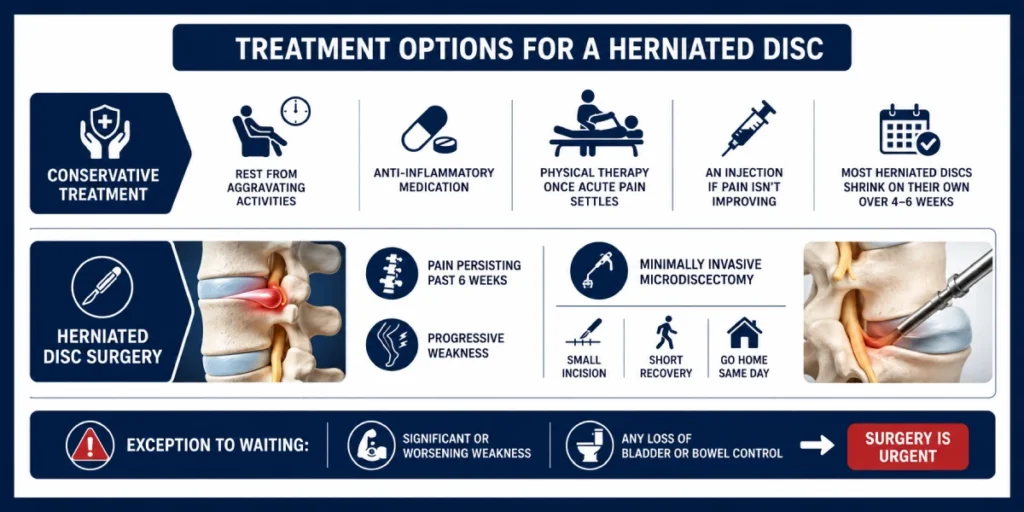
Disc herniation treatment also starts conservatively, for good reason. Most herniated discs shrink on their own as the body breaks down the extruded material, typically over four to six weeks.
Conservative Treatment
Rest from aggravating activities. Anti-inflammatory medication. Physical therapy once acute pain settles. An injection if pain isn’t improving on schedule.
Herniated Disc Surgery
Pain persisting past six weeks changes the calculation. So does progressive weakness.
Herniated disc surgery, usually a minimally invasive microdiscectomy, removes the fragment pressing on the nerve through a small incision. Short recovery compared to most spine procedures, and most patients go home the same day.
The exception to waiting: significant or worsening weakness, or any loss of bladder or bowel control, makes surgery urgent rather than elective.
Which Condition Is More Serious?
Neither, automatically.
Severity depends on how much the nerve is compressed and what that’s doing neurologically. Not the label. A small herniation may cause intermittent discomfort and clear on its own. Advanced stenosis can cut walking distance to a single block. A large herniation pressing on the nerve bundle at the base of the spine is a surgical emergency.
What matters: degree of compression, and whether strength, sensation, or bladder and bowel control are affected.
When Should You See a Spine Specialist?
Most patients never need urgent care. These findings are the exception:
- Progressive weakness in an arm or leg
- Loss of bladder or bowel control
- Numbness spreading through the inner thighs and groin
- Pain unchanged after six weeks of conservative treatment
- Walking distance or balance steadily worsening
The first three warrant same-day evaluation.
Final Thought
Timeline, cause, and how the nerve is being compressed. Those three things separate spinal stenosis from a herniated disc. One narrows slowly across decades. The other ruptures at a single level and often heals within weeks.
They overlap, though. They occur together. One can cause the other. So the answer comes from an exam room and a scan, not from a symptom list you found at midnight.
Pain that sticks around, gets worse, or starts eating into your strength deserves a proper look. Dr. Albert Wong, an expert spine specialist, sorts out which one you have and what to do about it.
Frequently Asked Questions
Can a herniated disc cause spinal stenosis?
Yes. Arthritis narrows the canal gradually. Disc material does the same thing faster by pushing into that space directly. On imaging, the compression looks much the same. What separates them is the cause, and now and then, the treatment.
Which condition is more likely to require surgery?
Herniated discs often settle without it, and younger patients tend to do well. Stenosis is different. Narrowing from bone and thickened ligament will not reverse itself. Over enough years, with enough symptoms, that difference tends to show up in the operating room.
How long does recovery usually take?
Four to eight weeks covers most herniated discs. Stenosis follows a different path entirely. The narrowing stays put, so symptoms hold or creep forward without treatment. That said, non-surgical care keeps plenty of patients comfortable for years.