

Most people don’t care about these terms until their back starts acting up. Then suddenly you’re reading scan reports that say “bulge” or “herniation,” and it all sounds the same.
It isn’t.
But yeah, they’re close enough that even people in clinics mix them up in conversation sometimes. So let’s get a clear idea of bulging disk vs herniated disk so that you never get confused again
Herniated Disc vs. Bulging Disc: What’s the Difference, Really?
First of all, you may already know that your spine is not one long, big bone. It is actually small bones stacked over one another, separated by a soft padding. That part is called a spinal disc.
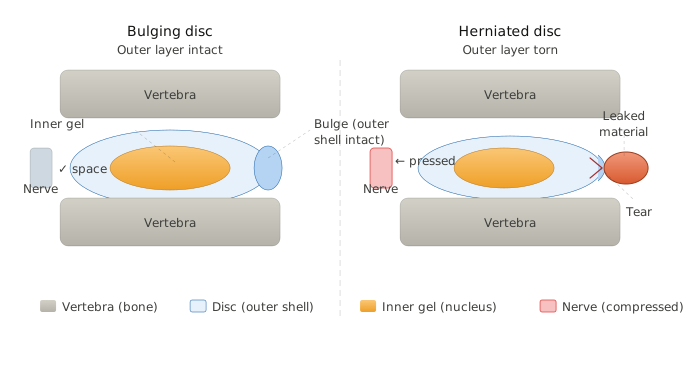
A bulging disc is basically a disc that’s starting to push outward. But the outer layer is still holding it together.
On the other hand, a herniated disc occurs when the outer layer actually tears and the inner material pushes out.
That’s the simple bulging disc vs herniated disc split. Not fancy medical words, just pressure vs actual break.
Why This Even Happens
You already know that the spinal disk sits between bones. Soft cushions. That’s their job.
Inside each disc, there’s a soft center and a tougher outer shell. Over time, that outer shell gets stressed. Age, lifting, posture, and accidents. All of it adds up.
That’s where you start seeing disc bulge or herniation show up. A bulge is usually slow wear. A herniation can be that same wear or a sudden push that goes too far.
Nothing about it is instant in most cases.
Bulging Disc (How It Usually Feels)
A bulging disc can be weird because sometimes it barely feels like anything. People live with it without knowing.
When it does show up, it’s usually:
- A dull ache in the back or neck
- Stiffness that comes and goes
- Mild tingling if a nerve gets lightly touched
This is where bulging disc and herniated disc symptoms overlap a bit. Because both can irritate nerves depending on where they sit.
In easy words, a bulge usually doesn’t scream at you. It kind of nags.
Herniated Disc (When It Starts Talking Louder)
This one tends to be more noticeable. The disc actually tears, and material slips out. And if it hits a nerve, you really feel it. The National Library of Medicine says that 1% to 3% of the entire population has herniated lumbar discs. So, it is a pretty common injury.
The signs include:
- Sharp pain that shoots down an arm or leg
- Numbness that doesn’t feel normal
- Weakness that wasn’t there before
This is why people compare a herniated disc versus bulging disk so often. The pain pattern can feel very different.
A herniated disc is not always worse than a bulged disc, but definitely more intense when nerves are involved.
The Real Difference Without Overthinking It
Let’s strip it down. Just the core components that separate these two conditions. It will be easier to grasp once we put it all in one table.
| Characteristic | Bulging Disc | Herniated Disc |
|---|---|---|
| Annulus fibrosus | Intact, weakened but continuous | Torn or ruptured |
| Nuclear material | Contained within the disc | Escaped through annular defect |
| Extent of protrusion | Broad, more than 25% of circumference | Focal, less than 25% of circumference |
| Canal involvement | Diffuse, mild narrowing | Localized, potentially severe compression |
| Pain mechanism | Mechanical pressure, inflammation | Mechanical compression + chemical inflammation |
| Nerve root involvement | Less common, indirect | More common, direct compression |
| Sciatica / radiculopathy | Possible but less frequent | Common, often the primary complaint |
| Symptom onset | Gradual, insidious | Can be sudden or gradual |
| Asymptomatic incidence | Very high (50–80% in older adults) | Lower but still significant (~30% in middle age) |
| Spontaneous resolution | Uncommon in shape; symptoms often resolve | Herniation can resorb; 60–80% improve |
| MRI appearance | Broad symmetric disc extension | Focal eccentric protrusion or free fragment |
| Common spinal levels | L4-L5, L5-S1, C5-C6 | L4-L5, L5-S1, C6-C7 |
| Initial treatment | Conservative: PT, NSAIDs, activity modification | Conservative first; injections if needed |
| Surgical rate | Low (under 5%) | Moderate (5–15% require surgery) |
| Recovery timeframe | Weeks to months | 6 weeks to 6 months; varies widely |
That’s the difference between a bulging disc and a herniated disc in real terms. Not that complicated once you get the basics.
Why People Confuse Them So Easily
Because they sit on the same spectrum. One often leads to the other over time. Therefore, you’ll see common Google searches like:
- Is herniated disc the same as bulging?
- Bulging vs herniated disc
- Herniated or bulging disc
- Disc bulge disc herniation
From a distance, it looks like one thing. Inside the spine, it’s just stages of wear showing up with different levels of intensity.
Treatment (What Usually Happens First)
Most cases don’t jump straight to anything extreme. Doctors usually start simple:
- Rest if needed.
- Some physical therapy.
- Medication for inflammation.
- Slow rebuilding of strength around the spine.
That’s usually enough in a lot of cases.
So when people look up herniated disc vs bulging disc treatment, the answer is often the same starting point. That’s another reason people get confused.
Surgery only comes in if things don’t settle or nerves are getting seriously affected. However, there is some good news. The U.S. National Institute of Neurological Disorders and Stroke found that most herniated disc cases improve without surgery over time.
So, don’t be scared if your reports say herniated disc. It probably will be fine with 4-6 weeks of rest.
When It Starts Becoming A Problem
Not every scan result means disaster. But it gets more serious when the following symptoms show up:
- Pain travels down the arms or legs
- Numbness sticks around
- Strength starts dropping
- Nothing improves after weeks of basic treatment
That’s usually the point where doctors stop guessing and start adjusting the plan. In severe cases, you may need to undergo a herniated disk surgery. If the disc is beyond repair, you can go for Artificial Disk Replacement (ADR) surgery.
Final Thought
The difference between a bulging disc vs herniated disc is not about fancy medical wording. It’s simple.
One is the disc stretching out. The other is the disc breaking open.
Same structure. Different levels of damage.
And in real life, doctors care way more about what you feel than what the report label says. So, if you start feeling something is off, find a spine specialist. Things get worse the longer you wait.
FAQs
What’s the difference between a bulging disc and a herniated disc?
It’s basically this: a bulging disc is still in one piece, just pushed out a bit. A herniated disc means it’s torn, and some of the inside is sticking out. So yeah, both are disc issues, but one hasn’t broken open, the other has.
Is a bulging disc the same as a herniated disc?
No. Close, but not the same. A bulge is more like the disc under pressure. A herniation is where it’s already split. People mix them up a lot, though.
Which one is worse?
Usually, the herniated one, but not every time. If it hits a nerve, that’s when it really starts bothering you. Pain can move, not just stay in your back. But sometimes it’s mild. Depends where it is more than anything.
What does a bulging disk feel like?
Could be nothing much at first. Or just a sore back that doesn’t go away. If it’s worse, you might feel pain going down your leg or arm. Sometimes tingling, sometimes a bit of numbness. It’s not the same for everyone.
Do people always need surgery for this?
No. Most don’t, actually. They deal with it through movement, some therapy, and letting things calm down. Surgery is more of a later option if it’s not improving.