

Choosing between an orthopedic surgeon and a neurosurgeon for cervical spine surgery can be difficult. Both doctors treat spine problems, but they focus on different areas.
An orthopedic surgeon mainly treats bones and joints. A neurosurgeon focuses on the brain, spine, and nerves.
This article explains the differences between the two specialists. It will help you decide which surgeon is right for your cervical spine surgery.
What is Cervical Spine Surgery?
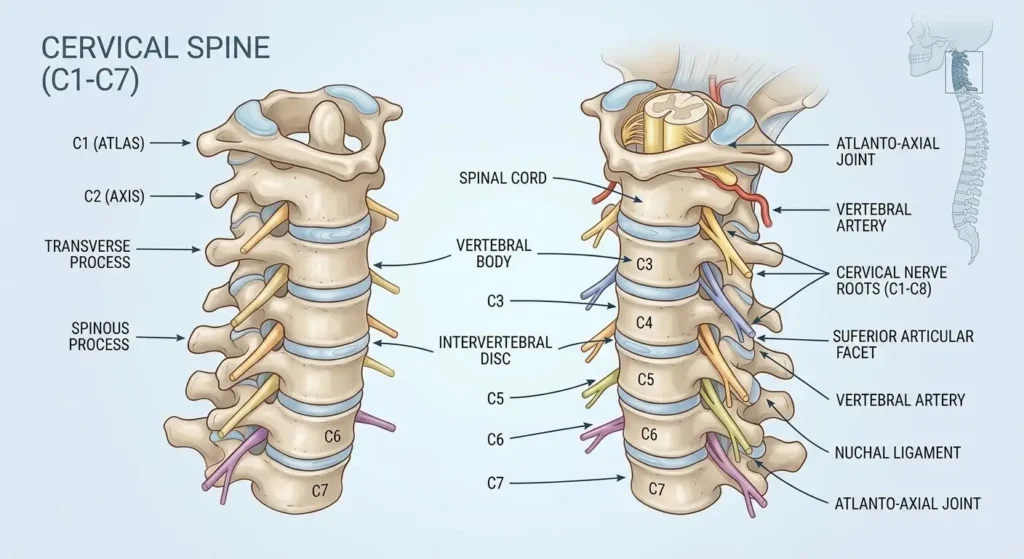
Cervical spine surgery is an operation on the neck part of your spine, which is called the cervical spine. This part of the spine supports your head and protects the spinal cord, which carries messages between your brain and body.
The surgery is done to fix problems such as:
- Herniated or slipped discs
- Spinal cord or nerve compression
- Degenerative disc disease
- Bone spurs or fractures
The goal of cervical spine surgery is to relieve pain, restore movement, and prevent further nerve or spinal damage.
What Does an Orthopedic Surgeon Specialize in for Cervical Spine Surgery?
An orthopedic spine surgeon diagnoses and surgically treats problems in the cervical spine (neck). The surgeon stabilizes bones, restores alignment, and relieves pressure on nerves. Common cases include spinal trauma, tumors, degeneration, and deformities.
Key Areas of Specialization:
- Degenerative Disc Disease: Treats herniated or worn-out discs that cause pain or nerve problems.
- Spinal Stenosis and Myelopathy: Relieves pressure on the spinal cord and nerves to reduce numbness, weakness, or pain.
- Spinal Instability and Fractures: Fixes structural issues in the neck caused by injury or trauma.
- Spinal Deformity: Corrects abnormal curvatures, such as kyphosis.
- Tumors and Infections: Treats tumors or infections in the cervical vertebrae.
Common Procedures Performed:
- Anterior Cervical Discectomy and Fusion (ACDF): Removes a damaged disc from the front of the neck and fuses the vertebrae.
- Artificial Cervical Disc Replacement (Arthroplasty): Replaces a damaged disc with an artificial one to maintain neck motion.
- Laminectomy/Laminotomy: Removes part of the vertebra to relieve nerve pressure.
- Posterior Cervical Fusion: Stabilizes the spine from the back of the neck.
- Minimally Invasive Spine Surgery (MISS): Uses specialized instruments to reduce tissue damage and speed up recovery.
Orthopedic spine surgeons master musculoskeletal biomechanics and often complete a dedicated spine fellowship, gaining advanced expertise to perform complex procedures safely and effectively.
What Does an Orthopedic Surgeon Specialize in for Cervical Spine Surgery?
An orthopedic spine surgeon is a doctor who focuses on the bones, joints, and structure of the spine. They treat neck and back problems that affect the spine’s strength, shape, and movement.
Training and teamwork
- After medical school, they do a 5‑year orthopedic surgery residency to learn about bones, muscles, and joints.
- Many then do a 1‑year spine surgery fellowship to focus on spine problems and surgeries.
- They often work with neurosurgeons to handle complex cases that involve nerves and bones.
What they treat
Orthopedic spine surgeons are experts in:
- Spinal deformities like scoliosis (sideways curve) or kyphosis (rounded upper back)
- Spinal instability or broken bones in the spine from injuries
- Degenerative problems like arthritis or worn-out discs
They also focus on how the spine moves and supports the body.
Common surgeries they perform
- ACDF (Anterior Cervical Discectomy and Fusion): removes a damaged disc and fuses the vertebrae
- Cervical disc replacement: replaces a worn disc with an artificial one to keep neck movement
- Laminoplasty or laminectomy: opens or removes part of a vertebra to relieve pressure on the spinal cord
- Spinal fusion and stabilization: uses plates, screws, or rods to make the spine stable
Both orthopedic spine surgeons and neurosurgeons can do many of the same spine surgeries. Which doctor you see depends on the type of problem and the surgeon’s experience.
What Does a Neurosurgeon Specialize in for Cervical Spine Surgery?
A neurosurgeon is a doctor who focuses on the nervous system; especially the brain, spinal cord, and nerve roots. They also treat many spine problems, especially when the spinal cord or nerves are involved.
Training
- After medical school, they complete a 7‑year neurosurgery residency. This teaches them how to work with the brain and spinal cord.
- Many then do 1–2 more years of spine fellowship training to focus on complex spine surgery.
- This training gives them microsurgical skills and precision to protect the spinal cord and nerves.
What they are especially good at
Neurosurgeons are trained to relieve pressure on the spinal cord and nerve roots.
They can treat things like:
- Herniated discs that press on nerves
- Spinal stenosis (narrowing of the spinal canal)
- Spinal cord tumors
- Nerve compression that causes pain, weakness, or numbness
They use tools like microscopes and tiny instruments to do surgery with very little damage to healthy tissue.
Common surgeries they do
- Microdiscectomy: removing part of a disc that is pinching a nerve
- Foraminotomy: making more space for a nerve to exit the spine
- Laminectomy or laminoplasty: widening the spinal canal to relieve pressure
- ACDF (Anterior Cervical Discectomy and Fusion): removing a damaged disc and stabilizing the neck
- Cervical corpectomy: removing a part of a vertebra to reduce pressure on the spinal cord
Neurosurgeons are often chosen when the nervous system is a big part of the problem — for example, when symptoms include severe nerve pain, weakness, or loss of coordination.
How Are Orthopedic Surgeons and Neurosurgeons Different in Cervical Spine Surgery?
Both orthopedic spine surgeons and neurosurgeons can perform many neck (cervical) spine surgeries. The difference is in their training, what they focus on, and the problems they are best at treating. In recent years, both types of doctors often get excellent results.
| Topic | Neurosurgeon | Orthopedic Spine Surgeon |
| Residency / Training | 7 years focused on brain, spinal cord, and nerves | 5 years on bones, joints, and muscles + 1-year spine fellowship |
| Main Focus | Nerves and spinal cord | Bones, joints, and spine structure |
| Special Skills | Surgery inside the spinal cord lining; microsurgery | Fixing major spine deformities; maintaining spine stability |
| Cervical Spine Surgery | Performs most ACDF surgeries; microsurgical approach | Focuses on stability and alignment; uses screws, rods, plates; more lower back fusions |
| Best for | Nerve problems: numbness, weakness, tingling, spinal cord tumors | Structural problems: spine curves (scoliosis, kyphosis), chronic neck pain |
| Surgery Style / Tools | Uses microscopes and tiny instruments to protect nerves | Uses hardware like rods, plates, and screws to stabilize spine |
| Unique Strength | Can operate inside dura (cord lining) | Expert at major structural corrections |
If you are deciding between these specialists, think about your symptoms. Nerve-related numbness or weakness may point to a neurosurgeon, while structural neck pain or major spine deformities may point to an orthopedic surgeon.
Which Specialist Should You Choose for Cervical Spine Surgery?
For cervical spine surgery, choose a fellowship-trained spine surgeon—either a neurosurgeon or an orthopedic surgeon. Focus on their experience with your specific condition, not just their title.
Key Considerations
Fellowship-trained: Surgeon has completed extra spine training and performs cervical surgery regularly.
Specific expertise:
- Structural issues → orthopedic surgeon
- Nerve-related issues → neurosurgeon
| Surgeon Type | Focus | Best For | Example Conditions |
| Neurosurgeon | Nerves, spinal cord | Nerve-related problems | Spinal cord tumors, syringomyelia, severe nerve compression, myelopathy |
| Orthopedic Spine Surgeon | Bones, structure, stability | Structural problems | Scoliosis, spinal instability, deformities, fractures, major reconstruction |
Both neurosurgeons and orthopedic surgeons can perform common cervical surgeries, like ACDF (anterior cervical discectomy and fusion), if they are fellowship-trained and experienced.
What Are the Success Rates and Risks for Cervical Spine Surgery?
Cervical spine surgery in Turkey, like ACDF or cervical disc replacement, is very successful. About 85%–95% of patients report less pain and better neck movement. Most procedures are safe, but risks do exist. These can include infection, bleeding, nerve injury, difficulty swallowing, and rarely, vertebral artery injury.
Success is high:
- ACDF relieves pain in 85%–95% of patients.
- Cervical disc replacement has over 90% patient satisfaction.
- Most patients experience lasting improvements in daily life.
- Commonly treats radiculopathy caused by cervical disc herniation.
Some complications are possible:
- Difficulty swallowing right after surgery occurs in 1.7%–67% of patients.
- Nerve damage may cause temporary arm weakness or vocal cord issues.
- Bleeding or wound hematoma happens in 1.3%–5.6% of cases.
- Infection risk is low, around 0.1%–1.6%.
- Nearby discs may degenerate later (about 8%).
- Fusion hardware can fail in 2%–30% of cases.
- Rare serious problems like spinal cord injury or esophagus perforation occur in less than 1%.
Factors that affect outcomes:
- Experienced, board-certified surgeons lower risks.
- Surgery is usually safe for older adults, but patients over 75 with myelopathy have slightly higher risks.
- Surgery from the back of the neck can cause more blood loss and higher infection risk than from the front.
Cervical spine surgery is generally safe and effective. Choosing the right surgeon and approach, and understanding risks, can improve results and recovery.
Conclusion
Choosing the right surgeon for cervical spine surgery is very important. Both orthopedic spine surgeons and neurosurgeons can do the surgery successfully. Your choice should depend on your problem.
- If you have structural issues, like spine curves, fractures, or instability, an orthopedic spine surgeon is usually best.
- If you have nerve problems, like numbness, weakness, or spinal cord pressure, a neurosurgeon may be better.
Cervical spine surgery, such as ACDF or disc replacement, works well for most patients. Many people feel less pain and move better after surgery. There are some risks, but choosing an experienced, board-certified, and fellowship-trained surgeon can lower them.
For patients in Los Angeles, Dr. Albert Wong, a neurosurgeon, is known for treating cervical spine and nerve problems. He is a strong choice for those with complex nerve or spinal cord issues.
Frequently Asked Questions
Is a neurosurgeon better than an orthopedic surgeon for cervical spine surgery?
Not always. Both neurosurgeons and orthopedic spine surgeons can perform cervical spine surgery. The best choice depends on your condition and the surgeon’s experience.
Who should I see for nerve problems in the neck?
If your symptoms include numbness, weakness, tingling, or spinal cord compression, a neurosurgeon may be the best specialist. They focus on the brain, spinal cord, and nerves.
Who treats structural problems in the spine?
Orthopedic spine surgeons usually treat structural problems. These include spinal deformities, fractures, instability, and alignment problems.
What is the most common cervical spine surgery?
One of the most common procedures is ACDF (Anterior Cervical Discectomy and Fusion). In this surgery, the damaged disc is removed and the vertebrae are fused to stabilize the spine.
What is the success rate of cervical spine surgery?
Most cervical spine surgeries are very successful. Around 85%–95% of patients report less pain and better movement after surgery.
How long does recovery take after cervical spine surgery?
Recovery time depends on the procedure. Many patients return to light activities within a few weeks, but full recovery may take several months.
How do I choose the right surgeon?
Look for a board-certified, fellowship-trained spine surgeon who has experience treating your specific condition. Experience often matters more than the surgeon’s specialty.