




Not sure whether to see a neurologist or a neurosurgeon? The difference can be confusing.
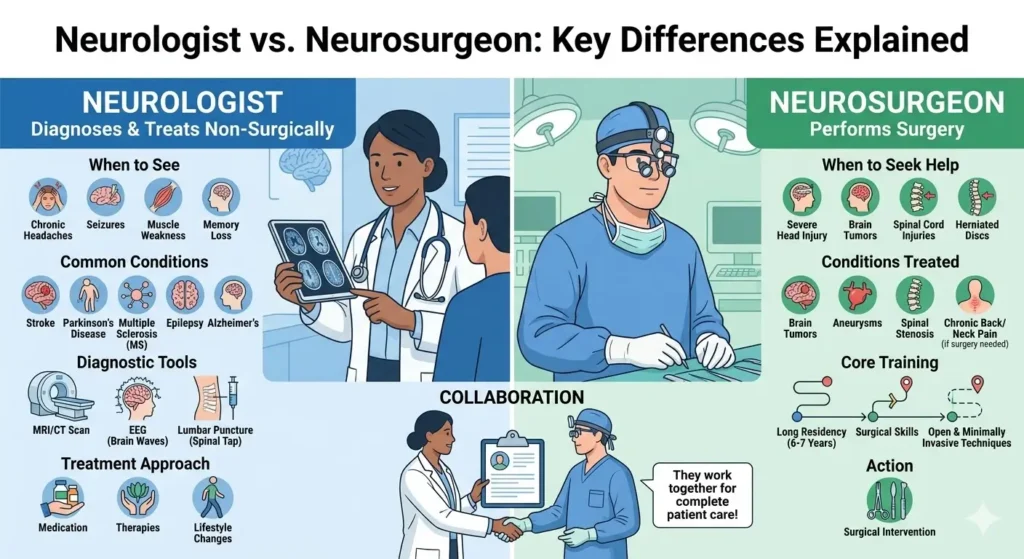
A neurologist diagnoses and treats nervous system conditions without surgery. A neurosurgeon performs surgery for serious neurological problems.
Knowing which specialist to consult is important for making smart healthcare decisions. This guide explains their roles and helps you choose the right expert.
When should you see a neurologist?
Neurologists treat problems in the brain, spinal cord, and nerves. They use medication, therapy, and lifestyle changes; no surgery.
Consider seeing a neurologist if you have:
- Chronic headaches or migraines – frequent or severe, affecting daily life
- Numbness or tingling – persistent pins-and-needles in your arms, legs, or face
- Seizures – unexplained shaking or loss of consciousness
- Memory problems – trouble remembering or concentrating
- Muscle weakness – sudden or unexplained loss of strength
- Tremors – uncontrollable shaking, especially in the hands
- Sleep problems – sleep apnea or restless leg syndrome
- Vision issues – blurred or double vision without a clear cause
- Balance problems – frequent dizziness or trouble walking
Early diagnosis helps prevent complications. A neurologist can find the cause and recommend the right treatment plan.
What Medical Conditions Do Neurologists Treat?
Neurologists diagnose and treat problems of the nervous system. This includes the brain, spinal cord, and peripheral nerves.
Common conditions treated by neurologists include:
- Stroke: Blood flow to the brain is blocked, causing damage.
- Parkinson’s disease: Causes tremors, stiffness, and movement difficulties.
- Multiple sclerosis (MS): The immune system attacks nerve coverings, affecting brain-body communication.
- Epilepsy: Causes repeated seizures.
- Alzheimer’s disease: A type of dementia affecting memory, thinking, and behavior.
- Peripheral neuropathy: Damage to nerves causing pain, numbness, or weakness in hands and feet.
- Migraine: Severe headaches with nausea, vomiting, and sensitivity to light or sound.
- Neurogenetic disorders: Inherited conditions like Huntington’s disease or muscular dystrophy.
- Sleep disorders: Conditions such as insomnia, sleep apnea, or restless leg syndrome.
- Traumatic brain injury (TBI): Brain damage caused by accidents or blows to the head.
Research from the National Institutes of Health (NIH) shows that early diagnosis and treatment are key to managing these conditions and improving quality of life.
Common Diagnostic Tools Used by Neurologists
Neurologists use different diagnostic tools to find and treat nervous system conditions. These tools show what might be causing your symptoms. Some common tools include:
MRI (Magnetic Resonance Imaging) and CT Scans
Neurologists use special tools to find and treat problems in the nervous system. These tools help show what is causing your symptoms. Some common tools are:
- MRI (Magnetic Resonance Imaging): Produces detailed images of the brain and spinal cord to spot tumors, injuries, or multiple sclerosis.
- CT Scan (Computed Tomography): Uses X-rays to create images of the brain, often used to detect brain injuries or bleeding.
- Non-invasive procedures: Both are non-invasive, meaning no surgery is required.
- Rapid results: These tests provide quick results, which helps in fast diagnosis.
- Guides treatment: MRI and CT scans help neurologists develop the best treatment plan.
These scans give important information about the nervous system. They help the neurologist decide the best treatment. If surgery is needed, a neurosurgeon can use these results to plan the procedure.
Electroencephalogram (EEG)
An EEG records the electrical activity in the brain. It’s often used to diagnose disorders that affect brain function, such as epilepsy or sleep disorders.
- Brain wave measurement: Measures the electrical activity in your brain, detecting abnormal patterns.
- Used for seizures: Helpful in diagnosing conditions like epilepsy or other seizure disorders.
- Simple procedure: Electrodes are placed on the scalp to monitor brain waves.
- Non-painful: The test is painless and does not involve any invasive procedures.
- Can track brain function: Useful in observing how the brain reacts during different conditions.
EEGs help neurologists detect irregular brain activity and plan treatment for various neurological conditions. In cases where surgery is necessary, a neurosurgeon may be involved.
Lumbar Puncture (Spinal Tap)
A lumbar puncture, or spinal tap, is a procedure that collects cerebrospinal fluid (CSF) for testing. It can help find infections or problems in the brain and spinal cord.
- Collects cerebrospinal fluid: Fluid is taken from the spine to check for infections or abnormal substances.
- Helps diagnose infections: It’s commonly used to diagnose meningitis or encephalitis.
- Detects bleeding: Can also identify bleeding in the brain or spinal cord.
- Performed under local anesthesia: The procedure is done with minimal discomfort.
- Guides treatment plans: The results help neurologists decide the best course of action.
A lumbar puncture gives important information about the nervous system. It helps the doctor make a diagnosis. If surgery is needed, a neurosurgeon can take over.
Nerve Conduction Studies (NCS)
Nerve conduction studies (NCS) measure how well and how fast the nerves conduct electrical signals. It’s often used to diagnose nerve damage or muscle disorders.
- Measures nerve function: Helps assess the health of nerves by measuring electrical signals.
- Diagnoses nerve damage: Commonly used for conditions like peripheral neuropathy or carpal tunnel syndrome.
- Simple and quick: The test is non-invasive and provides fast results.
- Helps track muscle function: Also used to evaluate muscle disorders that affect nerve signals.
- Guides further tests: Results can help determine if more advanced tests are needed.
NCS helps diagnose problems with nerves and muscles. If treatment requires surgery, the neurologist may work with a neurosurgeon.
When Should You See a Neurosurgeon?
A neurosurgeon is a doctor who performs surgery on the brain, spine, or nerves. Neurologists handle many neurological problems, but neurosurgeons step in when surgery is needed.
Neurosurgeons treat conditions such as:
- Brain surgery: Remove tumours, repair blood vessel problems, or treat injuries
- Spinal surgery: Fix herniated discs, spinal cord injuries, or infections
- Trauma care: Perform life-saving surgery for severe head injuries
- Tumour removal: Remove or shrink benign or malignant brain tumours
- Complex nerve surgery: Treat conditions affecting the brain or spinal cord
You see a neurosurgeon only if surgery is required. They work closely with neurologists to decide the best treatment. Understanding the difference between a neurosurgeon and a neurologist helps you make informed healthcare decisions.
When Should You Seek a Neurosurgeon’s Help?
A neurosurgeon is needed when surgery is required or other treatments do not relieve your symptoms. You should see a neurosurgeon if you have:
- Severe head injury: A traumatic brain injury (TBI) that may need immediate surgery to prevent further damage
- Brain tumors: Tumors that require surgical removal or treatment
- Spinal cord injuries: Injuries needing surgery to reduce pressure or repair damage
- Herniated discs: Severe pain or weakness that cannot be treated without surgery
- Chronic back or neck pain: Conditions like spinal stenosis or degenerative disc disease that may need surgical relief
In these cases, a neurosurgeon performs surgery when a neurologist’s non-surgical treatments are not enough.
What Conditions Do Neurosurgeons Treat?
Neurosurgeons treat serious problems that affect the brain, spinal cord, nerves, and related structures. They use surgery and other medical treatments to help patients.
Common conditions include:
- Brain tumors (benign or cancerous) and cysts
- Head, brain, neck, or spine injuries
- Herniated discs and spinal stenosis that compress nerves
- Spinal fractures and deformities like scoliosis
- Hydrocephalus (fluid buildup in the brain)
- Peripheral nerve problems, such as carpal tunnel syndrome
- Epilepsy and seizure disorders that do not respond to medicine
- Vascular issues like aneurysms and arteriovenous malformations (AVMs)
- Congenital conditions (present at birth) such as Chiari malformation and spina bifida
- Chronic back or neck pain requiring surgery after other treatments fail
- Brain or spinal infections or abscesses that need surgery
Neurosurgeons often work with neurologists and other specialists. They decide the best treatment plan, which may include non-surgical options before considering surgery.
Training and Education: How Each Specialist Qualifies
Neurologists and neurosurgeons take different training paths, which explains why their roles are so distinct. Neurosurgery is one of the longest medical training programs in the world.
Neurologist training:
- Complete a medical degree (usually four years)
- One-year general internship
- Neurology residency for three to four years
- Optional fellowship in a subspecialty like epilepsy, movement disorders, or headache medicine
- Total training: about 10–12 years from medical school to independent practice
Neurosurgeon training:
- Medical degree and internship same as neurologists
- Neurosurgery residency for six to seven years (similar in other countries)
- Training covers: open brain surgery, minimally invasive techniques, spinal surgery, vascular surgery, and pediatric neurosurgery
- Optional fellowship for one to two years in a subspecialty such as spine, neuro-oncology, or cerebrovascular surgery
- Total training: about 14–16 years to practice independently
Both specialists must pass board exams and complete ongoing continuing education. By the time you see either one, they have spent over a decade gaining expertise in the nervous system.
Similarities Between Neurologists and Neurosurgeons
Neurologists and neurosurgeons both treat conditions related to the brain, spine, and nervous system. They share several key similarities:
- Expertise in the nervous system: Both have deep knowledge of the brain, spinal cord, and nerves.
- Diagnosis of neurological conditions: Both can identify problems such as brain tumors or spinal cord injuries.
- Collaboration: They often work together. A neurologist may diagnose a condition and refer the patient to a neurosurgeon if surgery is needed.
- Treatment of neurological disorders: Both aim to improve health and quality of life, though their methods differ.
Even though their roles are different, neurologists and neurosurgeons often work together to provide complete care for patients with neurological conditions.
How neurologists and neurosurgeons differ
Despite their shared focus on the nervous system, the two roles are distinct in training, methods, and the types of problems they address.
| Aspect | Neurologist | Neurosurgeon |
| Primary role | Diagnoses and treats neurological disorders without surgery | Performs surgery on the brain, spine, and nervous system |
| Treatment approach | Medication, therapy, lifestyle changes, and monitoring | Surgery and post-operative care |
| Typical conditions | Migraines, epilepsy, Parkinson’s, MS, neuropathy | Brain tumors, spinal injuries, herniated discs, traumatic brain injury (TBI) |
| Diagnostic tools | MRI, CT, EEG, lumbar puncture, nerve studies (NCS) | Imaging for surgery planning; intraoperative monitoring |
| Collaboration | Refers patients to neurosurgeons if surgery is needed | Works with neurologists for pre- and post-surgery care |
How to Find the Right Specialist
Finding the right specialist is important for effective treatment. Here’s how to choose the right one for your health needs:
- Identify your symptoms: Start by clearly understanding your symptoms. For example, if you have persistent headaches or memory problems, a neurologist may be the right choice.
- Consult your primary care doctor: Your primary care doctor can guide you to the right specialist based on your symptoms and medical history.
- Understand the specialist’s role: Knowing the difference between specialists, like a neurologist or neurosurgeon, helps you choose the right care. A neurologist treats conditions without surgery, while a neurosurgeon performs surgery.
- Get recommendations: Ask friends, family, or other healthcare providers for recommendations, as trusted referrals often lead to quality care.
- Check credentials and experience: Look for a specialist with the right qualifications, experience, and a good track record for treating your condition.
These steps will help you find a specialist who is best suited to address your specific health needs.
Conclusion
Knowing the difference between a neurologist and a neurosurgeon helps you make the right healthcare choices.
- Neurologists treat neurological conditions without surgery.
- Neurosurgeons handle serious cases that require surgery.
Both specialists are important and often work together to provide complete care.
If you have nervous system symptoms, start with a neurologist for diagnosis and non-surgical treatment. See a neurosurgeon if surgery is needed. Knowing which specialist to consult ensures you get the best care.
Frequently Asked Questions (FAQ)
What is the core difference between a neurologist and a neurosurgeon?
A neurologist treats neurological conditions using non-surgical methods, such as medication, physiotherapy, and monitoring. A neurosurgeon operates on the brain, spine, or nerves when surgery is the most appropriate treatment.
How will I know which specialist I need?
Your primary care doctor usually guides you. If symptoms are new or unexplained, a neurologist is typically the first referral. If imaging shows a structural problem, such as a tumour, herniation, or bleed, a neurosurgical consultation is usually the next step.
Can a neurosurgeon treat conditions without operating?
Yes. Neurosurgeons are trained physicians and may manage some conditions conservatively, especially for monitoring or follow-up. However, their main expertise is surgical intervention.
What symptoms typically require a neurologist versus a neurosurgeon?
Chronic headaches, seizures, tremors, or memory problems usually lead to a neurologist first. Symptoms caused by structural damage, such as severe head trauma, a known tumour, or progressive weakness from a herniated disc, often require a neurosurgeon.
How long does it take to become a neurologist or neurosurgeon?
A neurologist typically completes 10–12 years of training, including a 3–4 year residency. A neurosurgeon’s path is longer, about 14–16 years, including a 6–7 year surgical residency covering the brain and spine.
Will I need to see both specialists for the same condition?
For many serious neurological conditions, such as brain tumours, epilepsy being considered for surgery, or complex spinal disorders, yes. A neurologist manages the medical side, like symptom control and monitoring, while a neurosurgeon handles the surgery and follow-up. This shared approach is the best practice for conditions needing both medical and surgical care.