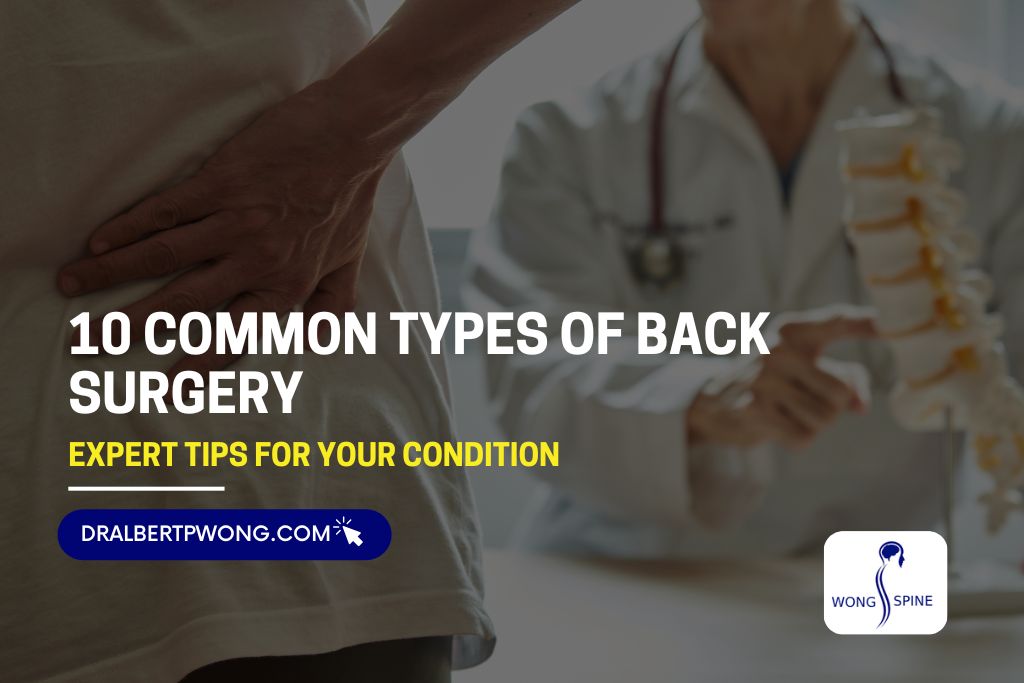
Back surgery targets the spine, vertebrae, discs, joints, and nerves.
It treats degenerative disc disease, herniated discs, fractures, instability, deformity, and nerve compression.
Surgical methods remove damaged bone.
- They repair or replace discs.
- They widen nerve pathways.
- They stabilize spinal segments using rods, screws, bone grafts, or artificial implants.
Some procedures preserve motion. Other procedures create fusion for support and alignment.
This guide explains 10 back surgery types.
Each type focuses on spinal stability, nerve relief, disc repair, vertebral support, joint fusion, and structural correction.
The goal is restored function and controlled movement.At Wong Spine, Dr. Albert Wong, neurosurgeon in Los Angeles, performs advanced spinal procedures to improve function, stability, and controlled movement.
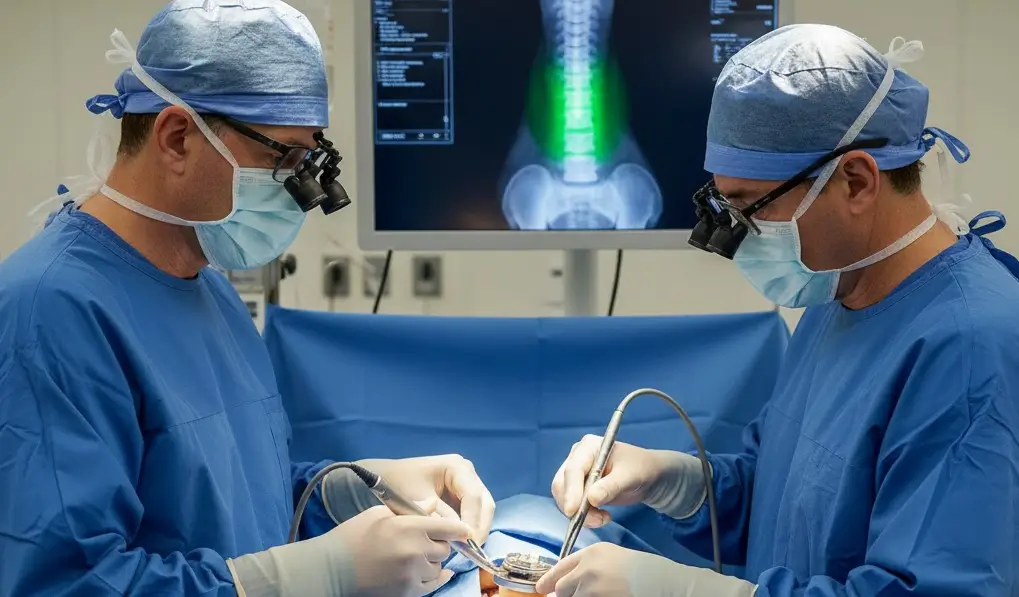
1. Spinal Fusion Surgery
Spinal fusion is a surgical procedure that permanently joins two or more vertebrae in the spine. By eliminating movement between these vertebrae, it helps reduce pain, improve stability, and prevent abnormal motion that can cause further damage.
Conditions Treated:
- Degenerative disc disease.
- Spondylolisthesis.
- Spinal instability caused by injury or wear and tear.
Procedure Details:
- Bone grafts are used to encourage the vertebrae to grow together naturally.
- Screws, rods, or plates may be added to hold the vertebrae in place.
- Can be performed in different areas of the spine, including the cervical (neck), thoracic (mid-back), or lumbar (lower back) regions.
Purpose and Benefits:
- Stabilizes the affected area of the spine.
- Reduces pain caused by abnormal movement or nerve irritation.
- Prevents further injury and improves overall spinal alignment.
- Helps patients regain mobility and perform daily activities with less discomfort.
2. Laminectomy
Laminectomy is a surgical procedure that removes a portion of the vertebra called the lamina. This creates more space in the spinal canal and relieves pressure on the spinal cord or nerves. It is often performed when nerve compression causes pain, weakness, or numbness.
Conditions Treated:
- Spinal stenosis.
- Herniated discs.
- Nerve compression.
Procedure Details:
- Removes bone, ligaments, or soft tissue pressing on nerves.
- Can be performed in different areas of the spine depending on the location of the pressure.
- May be combined with other procedures, such as spinal fusion, if additional stability is needed.
Purpose and Benefits:
- Reduces nerve compression and related pain.
- Improves mobility and daily function.
- Prevents further nerve damage.
- Can provide long-term relief for patients with spinal stenosis or herniated discs.
3. Discectomy
Discectomy is a surgical procedure that removes a herniated or damaged disc in the spine. The goal is to relieve pressure on nearby nerves that may cause pain, weakness, or numbness.
Conditions Treated:
- Herniated discs.
- Nerve compression causing pain or numbness.
- Weakness in arms or legs due to disc pressure.
Procedure Details:
- Removes only the damaged portion of the disc.
- Can be performed in the cervical, thoracic, or lumbar spine depending on the affected area.
- Sometimes done using minimally invasive techniques to reduce recovery time.
Purpose and Benefits:
- Reduces nerve compression.
- Relieves pain and discomfort.
- Restores mobility and function.
- Effective in improving symptoms caused by disc herniation.
4. Microdiscectomy
Microdiscectomy is a minimally invasive version of a traditional discectomy. It removes a small portion of a herniated disc to relieve pressure on the spinal nerves, reducing pain and improving function.
Conditions Treated:
- Herniated discs causing nerve compression.
- Sciatica or leg pain from compressed spinal nerves.
- Numbness or weakness due to disc pressure.
Procedure Details:
- Performed through small incisions.
- Uses a microscope or specialized instruments for precision.
- Targets only the damaged portion of the disc.
- Minimizes tissue damage compared to traditional discectomy.
Purpose and Benefits:
- Reduces nerve pressure and pain.
- Speeds up recovery time.
- Lowers risk of complications.
- Helps patients return to daily activities more quickly.
5. Artificial Disc Replacement
Artificial disc replacement is a surgical procedure that removes a damaged or degenerated spinal disc and replaces it with a synthetic disc. This procedure preserves natural spine movement and offers an alternative to spinal fusion, which limits motion in the treated area.
Conditions Treated:
- Degenerative disc disease.
- Disc damage causing pain, weakness, or limited movement.
Procedure Details:
- The damaged disc is carefully removed.
- A synthetic disc implant is placed between the vertebrae.
- The implant restores normal spacing and alignment of the spine.
Purpose and Benefits:
- Relieves pain caused by damaged discs.
- Preserves spinal flexibility and motion.
- Maintains overall spine alignment and function.
Helps patients return to daily activities with improved comfort.
6. Vertebroplasty
Vertebroplasty is a minimally invasive procedure that treats compression fractures in the spine. It stabilizes the fractured vertebra by injecting a special cement into the bone.
Conditions Treated:
- Spinal fractures caused by osteoporosis.
- Vertebral collapse.
Procedure Details:
- A small needle injects cement directly into the fractured vertebra.
- Stabilizes the bone and prevents further collapse.
Purpose and Benefits:
- Relieves pain quickly.
- Restores vertebral stability.
- Minimally invasive with a short recovery time.
7. Kyphoplasty
Kyphoplasty is similar to vertebroplasty but uses a balloon to create space in the fractured vertebra before injecting cement. This restores vertebral height and reduces spinal deformity.
Conditions Treated:
- Spinal fractures caused by osteoporosis.
- Vertebral collapse with height loss.
Procedure Details:
- A balloon is inserted into the vertebra and inflated.
- Space is filled with cement to stabilize the bone.
- Helps restore normal vertebral shape.
Purpose and Benefits:
- Reduces pain from fractures.
- Restores vertebral height and alignment.
- Improves posture and spinal stability.
8. Sacroiliac Joint Fusion
Sacroiliac joint fusion stabilizes the sacroiliac joint, which connects the lower spine to the pelvis. The procedure reduces pain caused by joint dysfunction.
Conditions Treated:
- Sacroiliac joint dysfunction.
- Chronic lower back or pelvic pain.
Procedure Details:
- Fusion of the sacroiliac joint using implants or bone grafts.
- Prevents abnormal movement in the joint.
Purpose and Benefits:
- Relieves lower back and pelvic pain.
- Improves function and stability.
- Reduces chronic discomfort.
9. Spinal Osteotomy
Spinal osteotomy involves removing a portion of bone to correct spine deformities such as scoliosis or kyphosis. It realigns the spine and improves posture.
Conditions Treated:
- Scoliosis.
- Kyphosis.
- Severe spinal deformities.
Procedure Details:
- Section of bone is removed from the spine.
- Spine is repositioned and realigned.
Purpose and Benefits:
- Corrects spinal deformities.
- Improves alignment and posture.
- Enhances function and overall appearance.
10. Foraminotomy
Foraminotomy enlarges the small openings between vertebrae, called foramina, to relieve pressure on spinal nerves.
Conditions Treated:
- Herniated discs.
- Spinal stenosis.
- Nerve compression causing leg pain or numbness.
Procedure Details:
- Bone or tissue compressing the nerve is removed.
- Foramen is widened to reduce pressure.
Purpose and Benefits:
- Relieves nerve pain and numbness.
- Improves mobility and daily function.
- Prevents further nerve damage.
Conclusion
Back surgery offers a range of solutions for spinal conditions affecting vertebrae, discs, joints, and nerves. Procedures such as spinal fusion, laminectomy, discectomy, and artificial disc replacement are designed to relieve pain, restore spinal stability, correct deformities, and improve mobility. Minimally invasive techniques like microdiscectomy, vertebroplasty, and kyphoplasty provide faster recovery and targeted relief for specific conditions.
At Wong Spine, Dr. Albert Wong, spine suergeon in Los Angeles, specializes in advanced spinal procedures tailored to each patient’s needs. With a focus on spinal stability, nerve relief, and functional improvement, his treatments help patients regain comfort, movement, and quality of life.
Whether addressing degenerative conditions, fractures, nerve compression, or spinal deformities, modern back surgery can restore function, reduce pain, and support long-term spinal health.